My BLOG on DIY, Hacking and notes
This includes mostly useful information for myself and my BLOG about various free time projects.
Which are currently mostly hardware and electronics hacks
.
Besides this I'm fully occupied with programming the final parts of MPL, extending my software generation tools such as the precompiler. And finishing my PhD thesis text which is about Creating the integrated programming environment Multi Precision Lab using source code generation tools.
First time visitors, people with comments or questions are welcome to sign my guestbook . Some of my projects in my blog hit the masses like www.hackaday.com featuring binary clock and makezine featuring my Wii-remote hack resulting in 10000 new visitors on the day they appeared in my blog. Cya and have a nice day
.
3D Printer Farm nearing completion
Written by Walter Schreppers on 16/04/2013 15:31:47.My 3 Fully callibrated printers running now with printerface :
Little history on how I got to this point:
I started with a blue prusa version 1. This was with felt tips and during the skeinforge days, was a major challange to get working good enough to print new parts. Problems with it where the felt-tips instead of lm8uu bearigs are a real pain as it required constant recallibration of platform because the felts loosen during prints. I also did not have a heatbed in the beginning + I soldered my own electronics from scratch deadbug style onto an arduino mega:
To make things worse I had 3 different hot-ends that either broke or leaked. First challange was making a new gear because the original one was warped and caused long prints to fail:
Still I managed to get the blue prusa to print all parts for a second iteration:
The black prusa was my first truly self-replicated printer I made, already some parts updated from original prusa and solved most issues I had with my first printer, better stepper motors, lineair bearings made a big difference:
Tweaking parts in openscad:
On this second reprap I printed the WalleBOT v2 (white one in the middle):
WalleBOT v2 during construction (prusa with allmost all parts except foot vertexes tweaked/updated from thingiverse and openscad modded parts) this one not only prints much better it's also easily assembled in one day:
This 3rd iteration printed four more printers, 1 I sold on last month and this sprouted the idea for a webshop 3dkits.be and I'm now printing new parts for the original blue prusa, iterated by printing upgrades/spares for themselves
.
Here's a green WalleBOT v2.1 printed plate 1 done:
Jef assembling his WalleBOT during the first 3DKits.be workshop!
Few hours later nearing completion of frame:
Callibrating and first prints on the workshop built wallebot printer (a bit of bad luck, we had a malfunctioning psu and took off the heatbed to test. Luckily after changing the power supply, everything worked like a breeze and the first workshop was a success):
Back to printing more printers, here printing the printrbot (did not have fotos during construction but you can see it finished on the right in top picture of this post
):
Here's I vid I made during the printing of first parts of the black prusa (notice the home-made electronics just soldered directly deadbug-style to an arduino mega
.):
Compare it to using 'out of the box' electronics, and proper linear bearings and better steppers for much smoother printing nowadays (on the right I'm experimenting with abs-juice straight to glass, on left I'm using kapton tape. Kapton tape gives best results on heatbed. The abs juice worked for this yoda print but I wouldn't use it for a full build plate as you see it's got some warping in front left corner happening):
Prints with 0.4 mm nozzle, 0.25 mm layers:
The blue grand-daddy of the farm is being refactored now, vid soon 
ThermoPi part 2
Written by Walter Schreppers on 15/11/2012 13:33:53.The thermostat+raspberrypi+android project is nearing completion. Here's how it looks now on my wall:
And some pictures during buildup (finding an unused wire for feeding 5volts to the project
).
Fitting the raspberry pi inside the case:
The 3D stl files I made that allowed the casing to be printed on my 3d printers (forgot to take picture while printing, but hey you already saw the results which look good ):

Raspberry Pi web thermostat.
Written by Walter Schreppers on 15/10/2012 21:04:51.About a year ago I made this breadboard version of a web based thermostat.
It connects an arduino to a newit pc with usb and controls my central heating with a web interface.
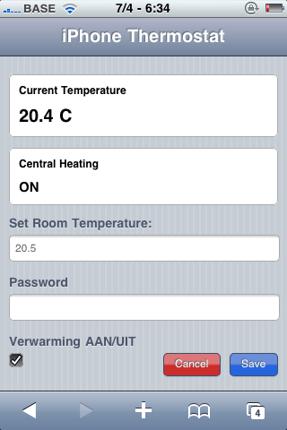
I dubbed it the iphone thermostat because the web interface worked well on an iphone (it mimics the iphone user interface with css/javascript):
iPhone thermostat
Well this weekend I decided to make a proper build of this idea. I've converted the breadboard and arduino into a single pcb (well stripboard with lotsa wires) and a standalone atmega328. I've got 4 wires left to do. +5v and gnd go to supply of the raspberry pi. TX and RX lines will go to the gpio of the raspberry pi (need a level shifter for that to go from 3.3 to 5v and waiting for that order ). Basically allowing me to run the web application on a raspberry pi and then have that control the wanted temperature.
Here is the build in progress:
Here is the build on my wall:
Tonight or tomorrow I'm gonna print a nice casing for it on my reprap.
Here is a video of it running for first time without arduino/breadboard:
Had a bit of a cold yesterday. Anyway I should mention it's going to be connected to a raspberry pi. The four wires you see in picture (is version on my wall today) are tx/rx for sending/receiving serial commands on the gpio of raspberry pi (much like sending g-codes to a printer, we can send and receive wanted and current temperature over serial). And a +5v & ground are exposed for also connecting to the raspberry pi. => Basically instead of using arduino usb serial, we use gpio to send/receive data from the atmega with a softserial and some gpio pins :
raspberry pi to arduino or atmega with gpio
The level shifter/buffer chip used in above link only costs about 40cents on mouser:
CD4050 level shift 3.3 to 5v
Ow yeah had a bit of a cold yesterday, so also forgot to mention the 12volt is used for switching on/off the relay. Most likely if i'd build this again I'd go for a 5v relay instead because then the 7805 regulator is not needed and I can use a 5v supply instead of a 12v supply. Also note that I like this not having batteries. The android post I saw is using the android battery, so that lasts about a day before your android is out of juice and you can't turn on your heat anymore
.
The cool thing is that this circuit already worked flawlessly an entire winter last year. It's standalone atmega 328p controlling the heater and the rasp-pi only exposes some json calls and webpages to controll the set temperature and read out the current temperature.